Between World Championship Thrills and Olympic Dreams: Zoe Song Is Helping Shape Munich’s Flag Football Boom
A Home World Championship That Surpasses All Expectations
When Zoe Song talks about the 2026 IFAF Flag World Championship in Düsseldorf, it quickly becomes clear that the four days of the tournament were far more to her than just another international competition. Family and friends in the stands, packed bleachers, and an atmosphere unlike anything she had experienced in her flag football career so far.
“It really was a ten-out-of-ten experience,” says Song. She was particularly impressed by the moment when she stood on the sidelines and spotted all the people in the stands who had come specifically to support the German team.
For Song, the home World Championship was also a sign of just how rapidly flag football is growing right now. Even Media Day before the tournament began felt different to the players than much of what they’d experienced before: interviews, photo shoots, livestreams, and significantly greater media attention turned the tournament into an event that felt “even more professional” to the national team player.
“You can really tell that a change is taking place in this sport right now.”
The game against the U.S. becomes a career highlight
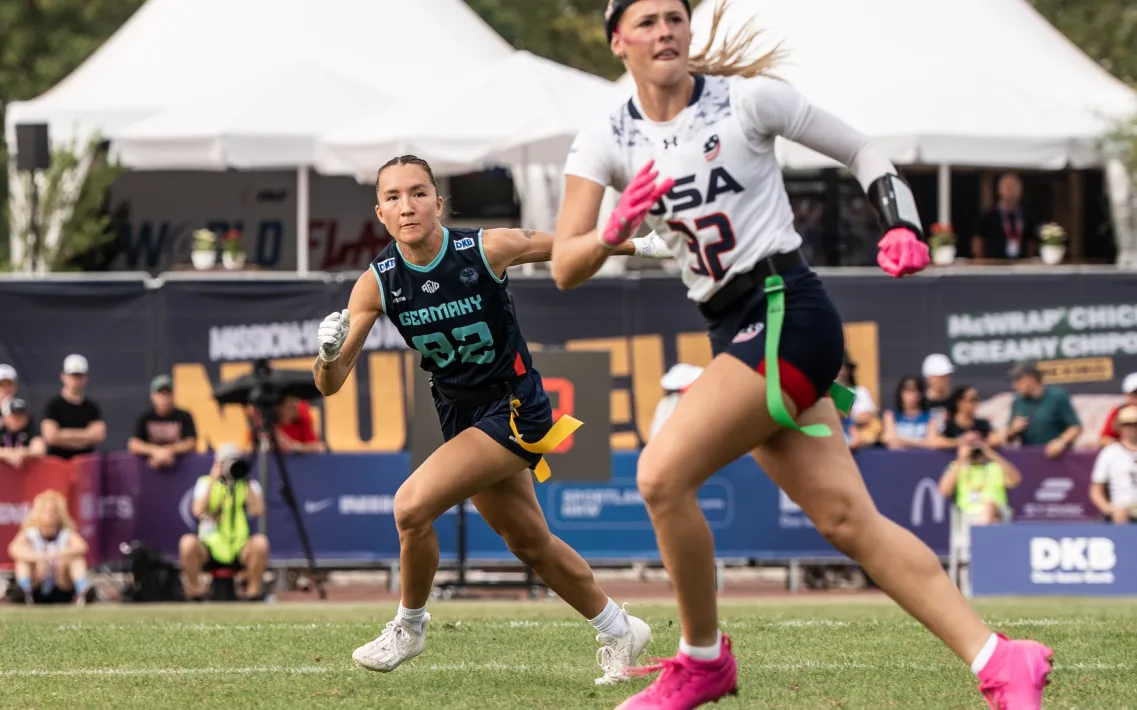
On the field, Germany initially achieved its goal of advancing past the group stage and ranking among the top eight teams in the world. In the quarterfinals, they faced none other than the U.S.—the global benchmark in flag football.
What followed became the highlight of Zoe Song’s career so far.
Germany went toe-to-toe with the world champions and ultimately lost by a narrow margin of 34–35. Precisely because an upset was within reach, pride and disappointment mingled after the game.
“Of course, you think to yourself: Just one point—it could have gone our way. Who knows how far we would have gone then,” says Song. “We were all down after the game, but at the same time euphoric because we played such a great game.”
The match demonstrated the potential the German team possesses.
“If we always played the way we did against the U.S., we’d have a much easier time against some other teams.”
The fact that Germany went on to finish in fifth place was therefore also a matter of self-belief. After the narrow loss to the world champions, the team wanted to show “that we can still compete at the very top.”
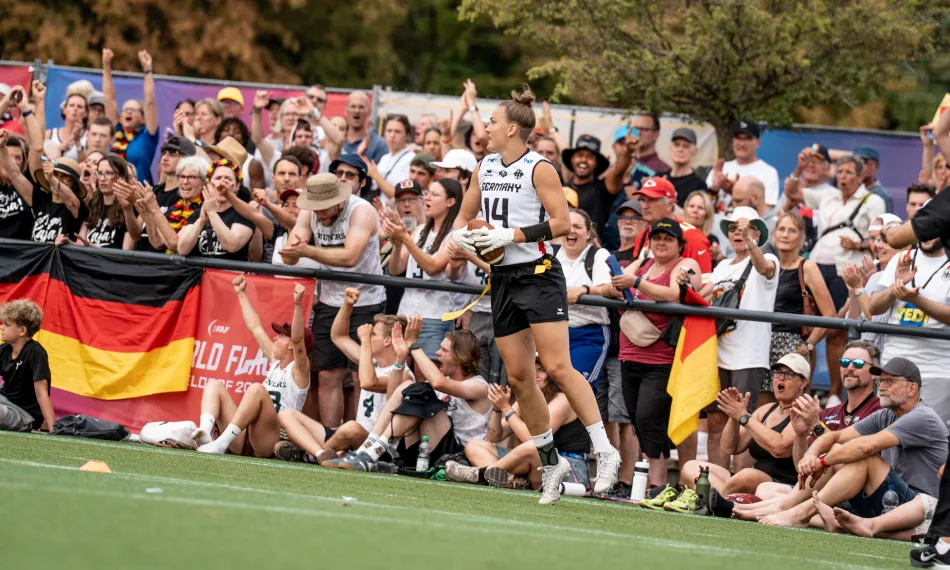
The Dream of Los Angeles Lives On
Direct qualification for the 2028 Olympic Games didn’t happen in Düsseldorf. But that doesn’t mean the dream of Los Angeles is over by any means.
First up in 2027 is the European Championship. There, Germany aims to secure one of the crucial spots on the path to Olympic qualification.
Song considers this goal realistic. At the World Cup, Germany was among the strongest European teams—but at the same time, the national team player knows just how close the competition has become.
“Flag football in Europe is already at a very high level. The teams are very evenly matched, and you can tell how everyone is constantly pushing each other to new heights.”
The World Cup therefore gave the German team not only confidence but also new motivation.
From the Gym Floor to Subsidized Competitive Sports
Song can describe from personal experience just how much the circumstances have changed.
Just a few years ago, the national team slept together in a gym during training camps because there wasn’t enough money for hotel stays. At the World Cup on home soil in Düsseldorf, however, the players were able to focus largely on their sport. Travel expenses were covered, and shuttle service, meals, and logistics were all taken care of on site.
For Song, the difference is enormous.
Added to this is the increasing level of support. Shortly before the World Championship, players received funding from Deutsche Sporthilfe for the first time. This could help better offset the enormous effort behind competitive sports.
After all, the actual work is often invisible to spectators: strength training, sprint training, film study, national team camps, and international travel all add to the training sessions and games at the club level.
“I think a lot of people don’t even realize how many hours of film review, gym work, sprint training, and practice go into it.”
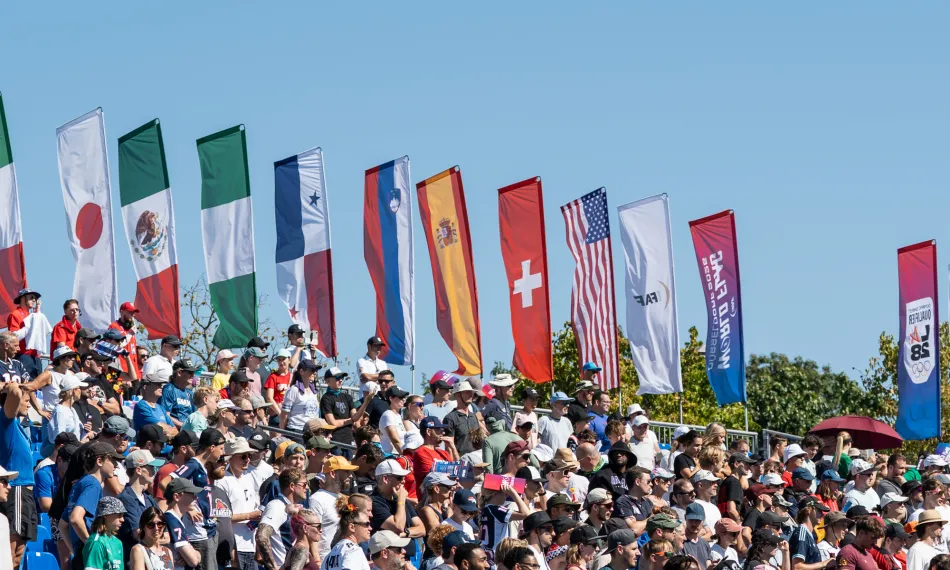
A Women’s League on the Rise
For Song, international development also requires a stronger national foundation. And that’s precisely where a tremendous amount has happened in a short time.
As she recalls, the German women’s league started with five teams in 2024. A year later, there were ten; by 2026, there were already 20 teams. More teams are already lined up for the upcoming season.
“That definitely benefits us,” says Song. After all, more teams also mean more high-quality games and thus more competition on a daily basis.
The national team, too, is now deliberately seeking out strong international opponents. In preparation for the World Cup, Team Germany played in Mexico and Panama, among other places.
For Song, all these factors are intertwined: more support, better infrastructure, stronger national competitions, and regular games against top international teams.
Munich Spatzen: Opponents Become Teammates
An important part of Song’s football life takes place in Munich. She had a strong season with the Munich Spatzen and finished as runner-up. Just a few weeks later, players who had faced off against each other in club competition took the field together for Germany.
It is precisely this dynamic that makes the flag football scene special for her.
“On game days in Germany, it’s really fun when you suddenly have your teammates from the national team on the other side and you know: Next week at training camp, we’ll be back on the field together.”
This also puts a loss in the final into a different perspective. Of course, she wants to win with the Spatzen. At the same time, she can be happy for her national team teammates when they’re successful with their clubs.
For the upcoming season, however, the goal in Munich is clear. After finishing third and then second, the next step is to move up.
“Next year, we’re definitely in the running for the championship,” says Song.
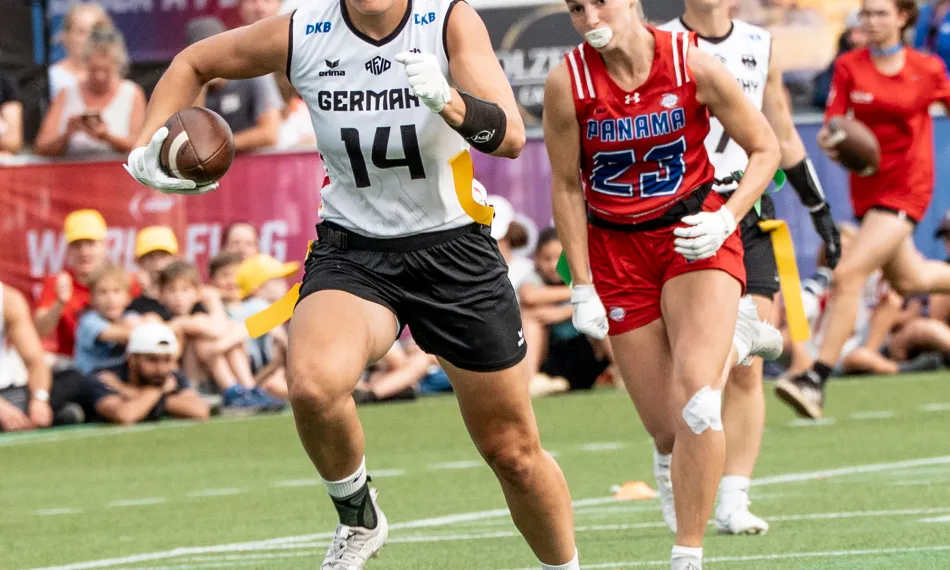
From Munich to the European Stage
She isn’t taking a long break after the World Cup. After a vacation in southern Spain, Song has already returned to training.
In October, another international tournament awaits the Munich Spatzen: the Champions Bowl in Croatia. There, successful club teams from various European countries will face off—for Song, another opportunity to compete at a high level.
It is precisely this international experience that is becoming increasingly important. After all, even in European flag football, there are now numerous teams with national team players who elevate their clubs to a correspondingly high level.
For the Spatzen, participating in this tournament is therefore not only an exciting way to wrap up the season but also another benchmark on their path to the top.
Flag Football Is Gaining Visibility—Thanks in Part to the NFL and the Olympics
Zoe Song has long been aware of the boom in her sport even off the field. The fact that flag football will become an Olympic sport in 2028, that NFL programming is expanding, and that events like the World Cup are receiving greater media coverage is changing public perception.
The World Cup held on home soil was perhaps the clearest example of this so far.
Flag football is no longer exclusively a sport within a small football community. The growing media attention, new teams, and increasing professionalization are reaching more and more people.
Munich also plays a special role in this development. With the Munich Spatzen, numerous football programs, and the NFL’s presence surrounding the 2026 NFL Munich Game, American football has long since become more visible in the city.
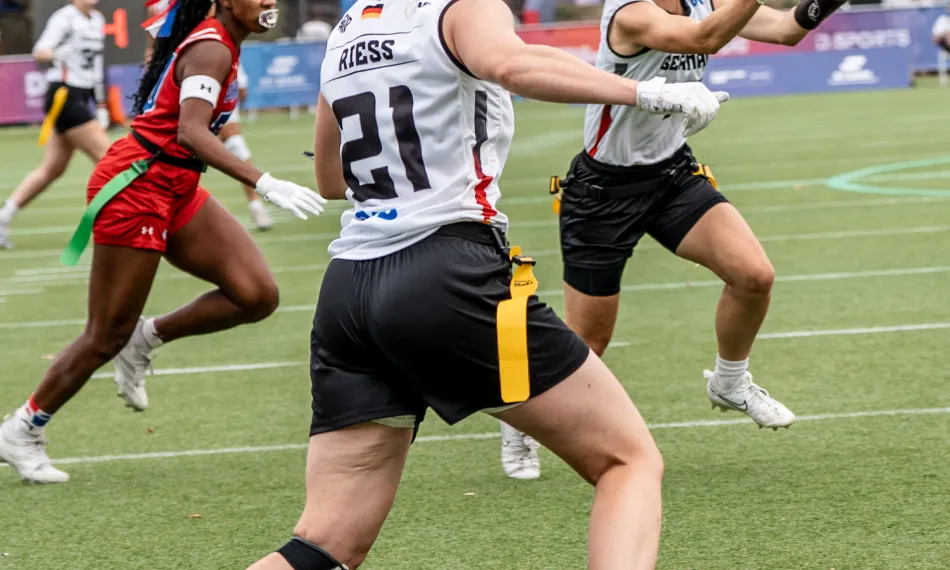
For Zoe Song, Munich also means balance
Despite all her athletic ambition, Munich is not just a training ground and venue for Song.
When she’s not on the football field, she’s drawn to the English Garden or the Isar, especially in the summer. For her, the combination of a big city and plenty of green space is one of the qualities that makes Munich special.
When it comes to food, she’s also reluctant to settle on a single favorite spot. Haidhausen, the Glockenbach district, or the university district offer her plenty of cafés and restaurants to keep trying something new.
It’s this mix that also defines her athletic home: Munich, the Munich Spatzen, and at the same time, a view out into the international flag football world.
The Next Step Is Gold
After a season that saw her team finish as runners-up in Munich and a home World Championship where they ranked among the top five teams in the world, one thing stands out for Zoe Song above all else: the gap to the top has narrowed.
Germany pushed vice world champion USA to the very last point. The national infrastructure is growing. Support is increasing. And with the 2028 Olympic Games on the horizon, there’s a goal that would have been almost unimaginable just a few years ago.
For Song, it’s therefore clear where the journey should lead: to the very top with the Munich Spatzen and to take the next step toward Los Angeles with Germany.
The 2026 IFAF Flag World Championship in Düsseldorf has shown that neither of these goals is a distant vision anymore.